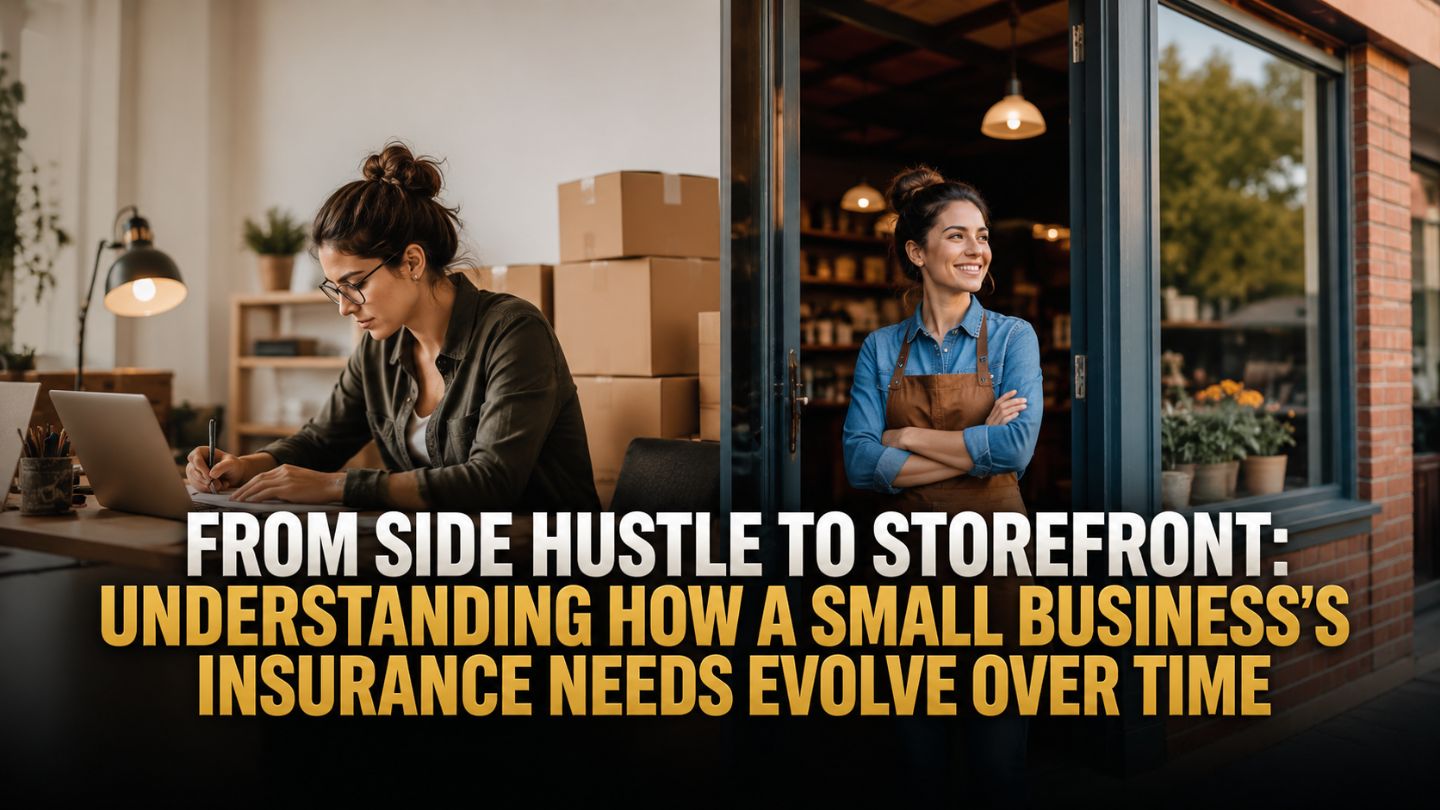
Every year, thousands of Atlanta entrepreneurs turn a weekend passion project into a full-time business. What starts as selling handmade candles on Etsy or tutoring students after work can quickly grow into a leased storefront with employees, inventory, and a steady stream of customers. As your business evolves through each stage of growth, your insurance needs shift dramatically-and failing to keep pace with those changes can leave you exposed to financial losses that could undo years of hard work.
This guide walks you through three distinct stages of business growth-side hustle, scaling venture, and established storefront-and explains exactly how your business insurance coverage should evolve at each step. Whether you’re running a home-based operation today or planning to sign a commercial lease next month, understanding these transitions helps you stay properly insured without overpaying for coverage you don’t yet need.
Key Takeaways
- Side hustles need basic liability protection; homeowners insurance typically covers only about $2,500 in business property and excludes business liability entirely.
- Growing businesses require specialized commercial insurance-including a business owner’s policy (BOP), commercial auto, and potentially workers’ compensation-as operations expand beyond the home.
- Established storefronts demand comprehensive coverage spanning property, general liability, workers’ compensation insurance, cyber liability, and industry-specific policies.
- Regular insurance reviews during each growth phase prevent dangerous coverage gaps that could lead to denied claims or legal penalties.
- An independent insurance agent can compare multiple carriers to find tailored solutions that evolve with your business needs and budget.
Stage 1: Side Hustle Insurance Basics
The earliest phase of any business carries more risk than many business owners realize. Whether you’re freelancing as a graphic designer, selling baked goods at weekend markets, or running an online shop from your kitchen table, your operations create exposures that your personal insurance policies were never designed to handle.
The most common mistake home-based business owners make is assuming their homeowners or renters insurance will protect them. In reality, homeowners or renters insurance generally does not cover business activities effectively. Most HO-3 and HO-5 policies include sub-limits of roughly $2,500 for business property on premises and as little as $500 off premises. Business liability-someone getting hurt by your product or at your home during a business interaction-is typically excluded altogether. For a deeper look at these limitations, see our guide on whether homeowners insurance covers a home business.
Consider an Atlanta-area maker who stores $5,000 worth of craft supplies and inventory at home. If a fire destroys that inventory, the homeowners’ policy covers only half. The remaining $2,500 comes straight out of pocket.
Even at this early stage, your risk profile includes potential bodily injury to a client visiting your home, property damage caused by a product you sell, or a professional error that costs a customer money. These aren’t hypothetical scenarios-they’re the kinds of claims that can wipe out a side hustle’s savings in a single incident.
Essential Coverage for Home-Based Operations
At the side hustle stage, you don’t need a massive insurance program, but you do need targeted protection for your specific activities:
- Business Personal Property Insurance : If your business equipment, tools, or inventory exceeds your homeowners sub-limits, a standalone business property endorsement or policy fills the gap. This covers your physical assets-whether that’s a $3,000 camera kit, sewing machines, or product inventory-at either replacement cost value or actual cash value.
- General Liability Insurance : Even a one-person operation benefits from general liability insurance. General liability insurance covers bodily injury and property damage arising from your business operations. If a client trips over equipment in your home office or a product you sold causes damage, GL responds. In Georgia, businesses with one to four employees pay an average of about $121 per month for $1 million per occurrence / $2 million aggregate limits.
- Professional Liability : For service-based side hustles-consulting, coaching, tutoring, design work-professional liability (also called errors and omissions insurance) covers claims of mistakes, negligence, or failure to deliver promised results. A professional services firm of any size can face these claims.
- Product Liability : If you sell physical goods-handmade jewelry, food items, cosmetics-product liability protection is essential. Higher volumes of sales increase liability risks, requiring product liability and professional liability insurance even at modest revenue levels.
Cost-wise, small businesses typically pay less for insurance coverage at this stage. A Georgia small business with roughly two employees, $150,000 in payroll, and $300,000 in revenue pays an average of about $102 per month for combined essential coverage. A solo side hustle with lower revenue would often pay less.
Stage 2: Scaling Business Insurance Requirements

The transition from side hustle to legitimate growing business is where insurance needs change most rapidly. You might be hiring your first employee, renting a co-working space or small studio, increasing inventory, making deliveries, or signing contracts with larger clients who demand proof of insurance. Each of these milestones introduces new risks that your existing policy wasn’t built to handle.
This is the stage where a business owner’s policy becomes the cornerstone of your insurance strategy. A BOP bundles essential coverages-general liability, commercial property insurance, and business interruption-into a single, cost-efficient package. Businesses with fewer than 100 employees generating less than $5 million in revenue typically qualify. In Georgia, a BOP for a small business averages about $149 per month, or roughly $1,793 per year. Bundling policies can lead to significant cost savings compared to purchasing each coverage separately.
As your business grows, several coverage requirements emerge simultaneously:
- Higher Liability Limits. More customers, bigger contracts, and expanding operations mean greater exposure. Many growing businesses move from $250,000/$500,000 liability coverage to $1 million or more per occurrence. Legal and contractual obligations may require specific types or limits of insurance coverage; landlords, vendors, and commercial clients frequently mandate minimums before signing agreements.
- Commercial Auto Insurance : The moment you start using a vehicle for deliveries, client visits, or transporting goods, your personal auto policy likely won’t cover you. Commercial auto insurance protects vehicles used for business purposes and is required under Georgia law for registered business vehicles. Typical costs in Georgia range from $1,200 to $4,000 per year, depending on vehicle type and usage. Owners who use separate personal and company vehicles should understand what full coverage insurance in Georgia generally includes, while recognizing that personal auto protection may not cover accidents that occur during commercial activities.
- Workers’ Compensation Insurance : Georgia law requires workers’ compensation insurance for any employer with three or more employees, including part-time and seasonal workers. Corporate officers and LLC members count toward this threshold. Workers’ compensation covers medical expenses and lost income for workplace injuries, and failing to carry it when required can result in fines and criminal misdemeanor charges.
- Business Interruption Coverage : Business income insurance replaces lost income during operational interruptions-whether from fire, storm damage, or other covered events. This coverage, typically included in a BOP, has become especially important as more businesses recognize the financial devastation that even a short closure can cause.
Common Mistakes to Avoid During the Growth Phase
The scaling phase is where coverage gaps most frequently develop. Here are the mistakes that cost growing businesses the most:
- Failing to update coverage limits as values increase : As inventory and business equipment grow in value, your policy limits need to keep pace. You should adjust coverage limits to reflect increased asset values. Georgia property policies commonly include coinsurance clauses requiring coverage equal to at least 80% of property value. Insure $80,000 worth of property when the replacement cost is $120,000, and your claim payout will be severely penalized-even for a partial loss.
- Ignoring the workers’ compensation trigger : Many business owners assume they can delay workers’ compensation until they have full-time staff. In Georgia, three or more persons regularly employed, including part-time workers, trigger the requirement. Waiting until you’re audited or an injury occurs is a costly gamble.
- Using personal vehicles for business without commercial auto insurance : Your personal auto insurer can deny a claim if the accident occurred during business use. This is one of the most common and easily avoidable coverage gaps.
- Not updating business classification : If your services have expanded-say you started as a product seller but now also offer consulting-your general liability policy may not cover professional negligence. You may need separate professional liability coverage. Businesses expanding into construction should also understand the coverage types included in general contractors’ insurance, as job-site accidents, equipment use, commercial vehicles, and subcontractor relationships can introduce specialized risks.
Insurance requirements evolve due to business growth, hiring, and the introduction of new products. Update policies when workforce size or business operations change to avoid being caught without the right coverage.
Stage 3: Established Storefront Comprehensive Coverage

Business owners who purchase a building and lease part or all of it to tenants should also understand how landlord insurance protects rental property owners, including coverage considerations for property damage, liability claims, and lost rental income.
At this stage, commercial property insurance is essential to protect your storefront, inventory, business equipment, and fixtures. Choose between “named peril” and “all-risk” policies, and between replacement cost value and actual cash value-the difference matters enormously when filing a claim. Commercial Property Insurance is needed to protect storefronts and their inventory, and the coinsurance requirements mentioned earlier become even more critical with higher property values at stake.
Beyond the core BOP, established storefronts need several additional layers of protection:
- Cyber Liability Insurance : A small business’s digital footprint expands with more customers, leading to increased data breach risks. If your storefront processes credit card transactions, maintains customer databases, or operates any digital operations like an e-commerce site, you face real cyber liability exposure. Georgia law (O.C.G.A. §10-1-910 to §10-1-912) requires businesses to notify individuals promptly after a data breach. Increased reliance on technology raises the need for cyber liability insurance to protect against data breaches. In Georgia, small businesses typically pay $1,000 to $3,000 per year for $1 million in cyber coverage. Premiums have been softening since mid-2022, making this coverage more accessible than ever. Businesses that implement security protocols like multi-factor authentication and encrypted backups often qualify for lower rates.
- Employment Practices Liability : With more employees comes greater exposure to claims of wrongful termination, harassment, or discrimination. This coverage responds to these claims, covering legal defense costs and settlements.
- Industry-Specific Policies : Depending on your business type, you may need food spoilage coverage, liquor liability, restaurant insurance, or product recall coverage. Expansion into regulated industries often comes with strict minimum insurance requirements. If your storefront is in a flood zone-relevant for several areas in metro Atlanta and Decatur-standard property insurance won’t cover flood damage, and a separate flood policy is necessary, especially if your property carries a federally backed mortgage.
- Umbrella / Excess Liability Policies : When your business assets, revenue, and customer exposure grow substantially, an umbrella policy provides additional coverage beyond your standard GL limits-often adding $1 to $5 million in protection for relatively modest premiums. For a storefront with significant foot traffic and contractual obligations, this layer of financial stability can be the difference between surviving a major claim and closing your doors.
Larger businesses face higher insurance costs due to increased risks, and multiple locations increase insurance premiums further. A small retail storefront in Georgia can expect to pay roughly $1,500 to $2,000 per year for a BOP, plus additional premiums for workers’ compensation, cyber liability, commercial auto, and any specialty coverages. Insurance costs increase significantly in high-risk industries such as food service or construction.
Insurance needs change as a small business transitions from low-visibility to high-visibility operations. Consulting insurance professionals helps identify coverage gaps you might not anticipate, and insurance professionals provide insights into new operational risks that come with rapid growth and an expanded physical footprint.
Building Confidence for Every Stage of Business Growth
As a business grows from a home-based side hustle to a thriving storefront, its insurance needs become more complex. Staying informed about changing risks, legal requirements, and coverage options helps protect the progress you’ve worked hard to achieve. Reviewing your policies as your operations expand can help reduce coverage gaps and provide greater confidence as your business reaches new milestones.
Whether you need auto insurance, general contractors’ insurance, landlord insurance, or personal insurance, Focus Insurance Group offers tailored solutions to meet your evolving needs. If you’re looking for dependableinsurance in Brookhaven, GA, our team is here to help you compare coverage options that fit your goals and budget. Contact us today to discuss the right protection for your business and personal assets with confidence.
Frequently Asked Questions
At what revenue level should I switch from homeowners to business insurance?
There’s no specific revenue threshold in Georgia law, but the practical trigger is when your business property or inventory exceeds your homeowners sub-limits (typically around $2,500), when customers visit your home for business purposes, or when a client or vendor contract requires proof of business insurance coverage. If any of these apply, your homeowners policy is no longer sufficient, and dedicated commercial insurance is the right move.
Do I need workers’ compensation insurance for my first part-time employee?
Not necessarily with just one. Georgia requires workers’ compensation insurance once you have three or more persons regularly employed, including part-time and seasonal workers. However, corporate officers and LLC members count toward that threshold, so a sole owner who forms an LLC, hires one part-time worker, and has one LLC member may already meet the requirement. Check your specific situation with a qualified insurance professional.
How much does business insurance cost for a small retail storefront in Atlanta?
A BOP for a small Georgia retail storefront typically costs $1,500 to $2,000 per year. Add general liability at roughly $1,452 per year for one to four employees, cyber liability insurance at $1,000 to $3,000, workers’ compensation, and commercial auto if applicable. Total annual insurance premiums for a fully covered small storefront often range from $4,000 to $8,000 or more, depending on location, inventory value, employee count, and industry.
What happens if I don’t update my insurance when my business grows?
The consequences can be severe. Coinsurance penalties on property policies mean reduced claim payouts if you’re underinsured. Claims tied to business activities excluded by your personal policies will be denied outright. Using personal vehicles for business without commercial auto coverage can leave you liable for the entire accident. In Georgia, failure to carry required workers’ compensation can result in fines and criminal charges. Beyond financial losses, you risk non-compliance with landlord and vendor contractual obligations.
Can I bundle my business and personal insurance policies for savings?
Business and personal insurance typically involve separate underwriting, so a true “bundle” isn’t always possible. However, working with the same insurance agent for both personal and business lines can sometimes yield multi-policy discounts. The bigger savings opportunity is bundling your business coverages-property, liability, and business interruption-into a BOP rather than purchasing each separately. An independent agent can help identify all available discount opportunities across carriers.
How often should I review my business insurance as my company grows?
At a minimum, review your insurance policies annually. Beyond that, trigger a review whenever your business hits a significant growth milestone: revenue doubles, inventory values increase substantially, you hire to the point of reaching three employees, you move to or lease a new location, you purchase new equipment, you add new services or enter new markets, or you begin processing more customer data. Regularly reviewing your coverage ensures it stays aligned with your actual business risk and prevents gaps that could prove financially devastating.